
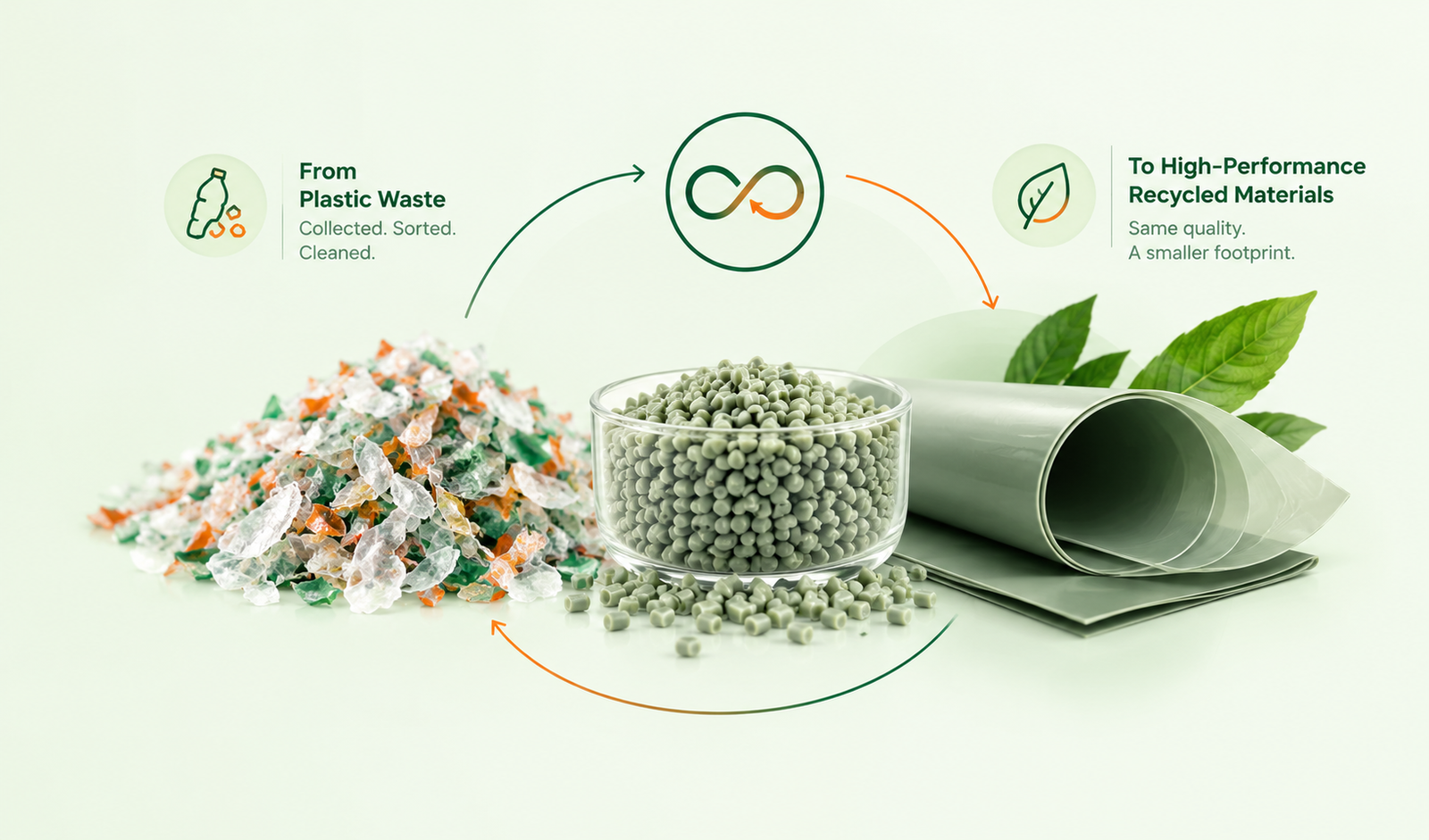
Extrusion and injection molding are two of the most widely used polymer-processing technologies.
Both processes require manufacturers to maintain consistent material flow, processing conditions, and finished-product performance.
When recycled materials or complex formulations are introduced, achieving consistent processing can become more challenging.
This is where polymer processing additives can provide value.
Why processing performance matters
A polymer formulation can have excellent theoretical properties but still present challenges during manufacturing.
Processing problems can affect:
- Material flow
- Cycle times
- Surface quality
- Dimensional consistency
- Energy consumption
- Production efficiency
- Finished-product performance
For manufacturers, the ability to process materials consistently is therefore just as important as the final material properties.
Polymer additives for extrusion
Extrusion continuously pushes polymer material through a die to produce products such as:
- Films
- Sheets
- Profiles
- Pipes
- Fibers
- Other continuous products
Material flow and processing stability are particularly important in extrusion.
A processing additive can be used as part of a formulation strategy to optimize how the polymer behaves during processing.
Therpol is designed to support processing and flow modification while also providing other functions within a polymer formulation.
Polymer additives for injection molding
Injection molding requires polymer material to flow into a mold and solidify into the required geometry.
Material behavior can influence:
- Filling
- Flow
- Surface finish
- Dimensional stability
- Cycle performance
- Mechanical properties
A multifunctional additive can help manufacturers investigate formulation options that balance processing requirements with finished-product performance.
The advantage of multifunctional additives
A conventional formulation may use separate additives for:
- Lubrication
- Impact modification
- Compatibilization
- Processing
- Flow modification
- Degassing
A multifunctional polymer additive takes a different approach.
Therpol is designed to combine several of these functions within one additive system.
This can reduce formulation complexity and potentially help manufacturers optimize raw-material usage.
Processing recycled polymers
Recycled polymers can introduce additional variability compared with virgin materials.
For manufacturers increasing recycled content, maintaining reliable processing can therefore become an important technical consideration.
Therpol is specifically positioned for recycling and compounding as well as injection molding, extrusion and fiber, blown film and blow molding applications.
Balancing processing and product performance
The ideal polymer formulation needs to balance processing behavior with final-product requirements.
An additive should not simply make material easier to process; manufacturers must also consider the required mechanical and physical properties of the finished product.
Therpol highlights technical characteristics including impact resistance, barrier properties, polymer compatibility, and flexural modulus alongside processing optimization.
Conclusion
Polymer processing additives can play an important role in helping manufacturers optimize extrusion and injection molding processes.
For companies working with recycled polymers or complex formulations, multifunctional additives offer another approach to managing compatibility, flow, processing and performance within a single formulation strategy.